I slid the dusty disc into my console two years late, but the moment Kay’s boots crunched across the Tosharan savannah, I was eighteen again—dreaming of worlds beyond the moisture farm, a blaster on my hip and a hungry little Merqaal at my side. The air smelled of ionized ambition and half-baked smuggling plans. Star Wars Outlaws had been waiting for me like an old cantina crook nursing a lukewarm spotchka, and I was ready to drink it all in.
My first few hours felt like dancing through a memory that had never actually happened. Strolling through Kijimi’s snow-dusted alleys, I could taste the crisp mountain air, each flake on my tongue a fleeting promise of danger and double-crosses. That promise was as seductive as a Jawa’s price on a slightly used droid. The developers at Massive Entertainment, hand in hand with Lucasfilm, had poured enough lore into every glowing console to make the galaxy feel lived-in. I would flick between planets like turning pages of a well-thumbed holojournal: the jungle-green vaults of Akiva, the arid monotone of Tatooine, and the savannah waterfalls of Toshara, a beautiful new moon that felt like a perfectly tuned synth-cello note on an otherwise familiar scale.
But sooner than I care to admit, that first thrill started to peel away like flimsiplast in a reactor leak. I was no Jedi, just a regular scoundrel, and the everyday tedium of being an Outer Rim nobody began to settle in. Each mission began to blur: sneak into a facility, steal a data rod, slip out unseen. The same identical door panels greeted me in every corner of the galaxy, the same crates and tables populating syndicate hideouts from Kijimi to Cantonica. It was as if the whole galaxy had been decorated by a single depressed interior designer who only stocked Sterile Bunker, Beige Edition. The cosmic vastness shrank until I could feel the walls closing in, each repeated location a carbon copy of the last, like listening to the same cantina band on six different worlds and realizing they only know one song.
Stealth was the main course, but it arrived undercooked. The vents were spotless, as if a cleaning droid had just passed through, yet I often found myself caught by Imperial eyes that could see through geography itself. Once, I was arrested behind a cliff face a hundred meters from the nearest Trooper—twice. Another time, I was perched on a ledge no enemy could reach, yet a uniformed officer somehow sensed my presence and slapped cuffs on me as if I’d been standing in front of him singing the Emperor’s anthem. The wanted system hummed with the irrational logic of a broken navicomputer. My blaster’s stun pulse, the one tool that shimmered like a lifeboat on a sinking frigate, came with a cooldown so long I could age a bottle of Corellian whiskey in between shots. The developers seemed to want me to charge in guns blazing, yet stripped away every mechanical incentive to do so. I felt like a kowakian monkey-lizard juggling thermal detonators, never sure which one would blow up in my face.
Combat itself was a hollow anthem. My shots landed with the weight of a whisper, and enemies dropped the exact same two items with all the variety of a binary sunset. Worse, Kay would toss aside any scavenged weapon as if it were infected with rakghoul plague the moment I tried to climb a ladder or slip into a vent. That tactical sniper rifle I’d just pried from a dead pirate? Gone, discarded like a half-eaten jogan fruit. It was the kind of logic that makes you stare at the screen and wonder if your own blaster’s stun pulse had somehow short-circuited your brain.
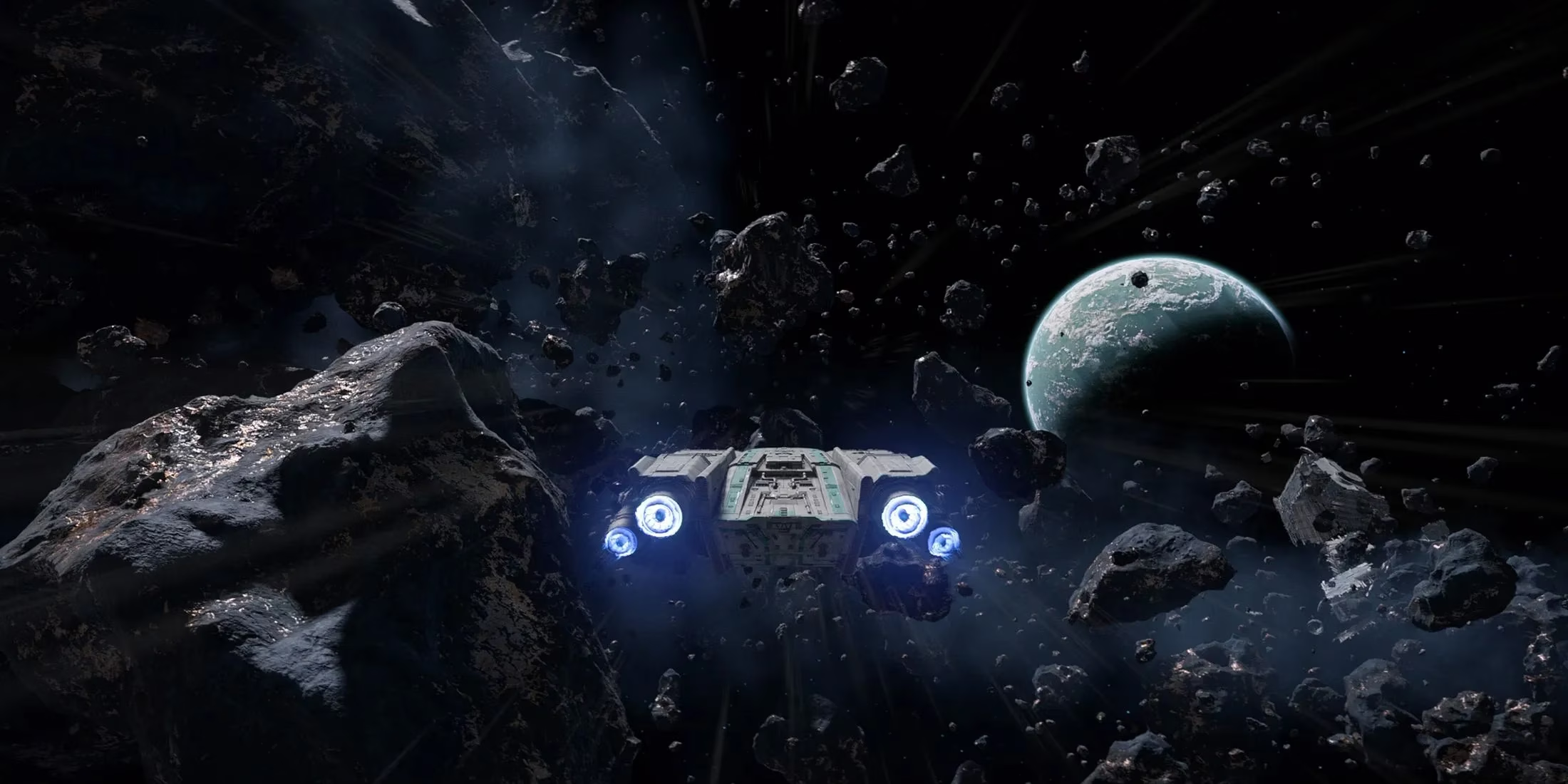
Yet, even as the cracks spread like ice on Hoth, I found myself unable to eject. There was Nix—the little Merqaal fuzzball who became my anchor. He was no mere combat pet; he was a partner in crime, a furry salvation. With a chirp, he could sabotage alarm panels, distract guards by playing dead, and snatch credits from purses with all the innocent charm of a loth-cat stealing a fish. I’d pause missions just to feed him snacks in a brief, whimsical minigame that felt like a stolen kiss in a war bunker. Then there was the Trailblazer, my upgradable light freighter, which I’d pilot through asteroid fields and into Imperial space ports, smuggling spice and stolen art like a true Outer Rim entrepreneur. The whole game became less about the missions and more about the spaces in between—the quiet hum of the hyperdrive, the soft glow of a Tatooine twin-sunset as I sat outside a cantina just watching speeders blur past.
And I must confess: the card game Sabaac swallowed whole afternoons. That simple, elegant system of betting and bluffing wormed its way into my routine like a Hutt’s into a wealth vault. I’d sit down for one hand, and suddenly the moon had risen twice. The skill system, too, pleased me in unexpected ways. Rather than a skill tree that bloomed like a predictable flower, I had to seek out teachers across the galaxy and perform specific tasks. To learn Lightfoot, I helped a disgruntled mechanic, lockpicked three doors, smuggled a crate of illegal medpacs, and took down an Imperial officer before I could walk on eggshells without cracking them. That organic growth felt earned, like finally unlocking a new chord on a battered instrument.
Now, in the rearview of 2026, I see Star Wars Outlaws as a ship that took on too much water but never quite sank. It is a game built with ambition as vast as the Akivan canopy, yet held back by repetitive stitching and bugs that gnawed at my patience like Mynocks on an unwatched power cable. The graphics, even on a modern machine, didn’t make my jaw unhinge—the planets were pretty in a postcard sense but lacked the soul-shaking depth I’ve seen elsewhere. Still, I sank twenty-some hours into it, and by the time the credits rolled, I was grateful. The scoundrel’s life fit me like a worn jacket, frayed in places but warm enough for one more adventure. If a sequel ever arrives, I’ll be first in line, hoping the next voyage sands down the rough edges without losing the stardust that made this one glow, however faintly, in the dark.