The landscape of choice-driven gaming has shifted dramatically since the early days of Fable and Mass Effect. These franchises taught players that their decisions could shape entire worlds, but as 2026 rolls on, a nagging question lingers: are those choices truly free, or merely a well-crafted illusion? While the new Fable and the next Mass Effect have finally arrived — or are at least grazing the horizon — Massive Entertainment’s Star Wars Outlaws has already thrown down a gauntlet, demonstrating a reputation system that offers genuine moral ambiguity. If these storied series wish to stay relevant, they would do well to take notes from Kay Vess’s morally gray journey.
For decades, games like Fable and Mass Effect have been the gold standard for narrative agency. Who could forget the stark binary of saving or sacrificing the Council, or the angelic glow of a pure-alignment hero? Yet, a closer inspection reveals a hidden curriculum: most of these games subtly (or not so subtly) nudge players toward the “good” path. Multiple endings are often tagged as “best” or “worst,” and a paragon/renegade meter silently judges every action. This design, while satisfying a power fantasy, inadvertently cheapens the weight of decision-making. After all, if the game applauds one route and shames the other, how much are we really steering the ship? Why did it take an open-world scoundrel sim to show us what true narrative freedom looks like?
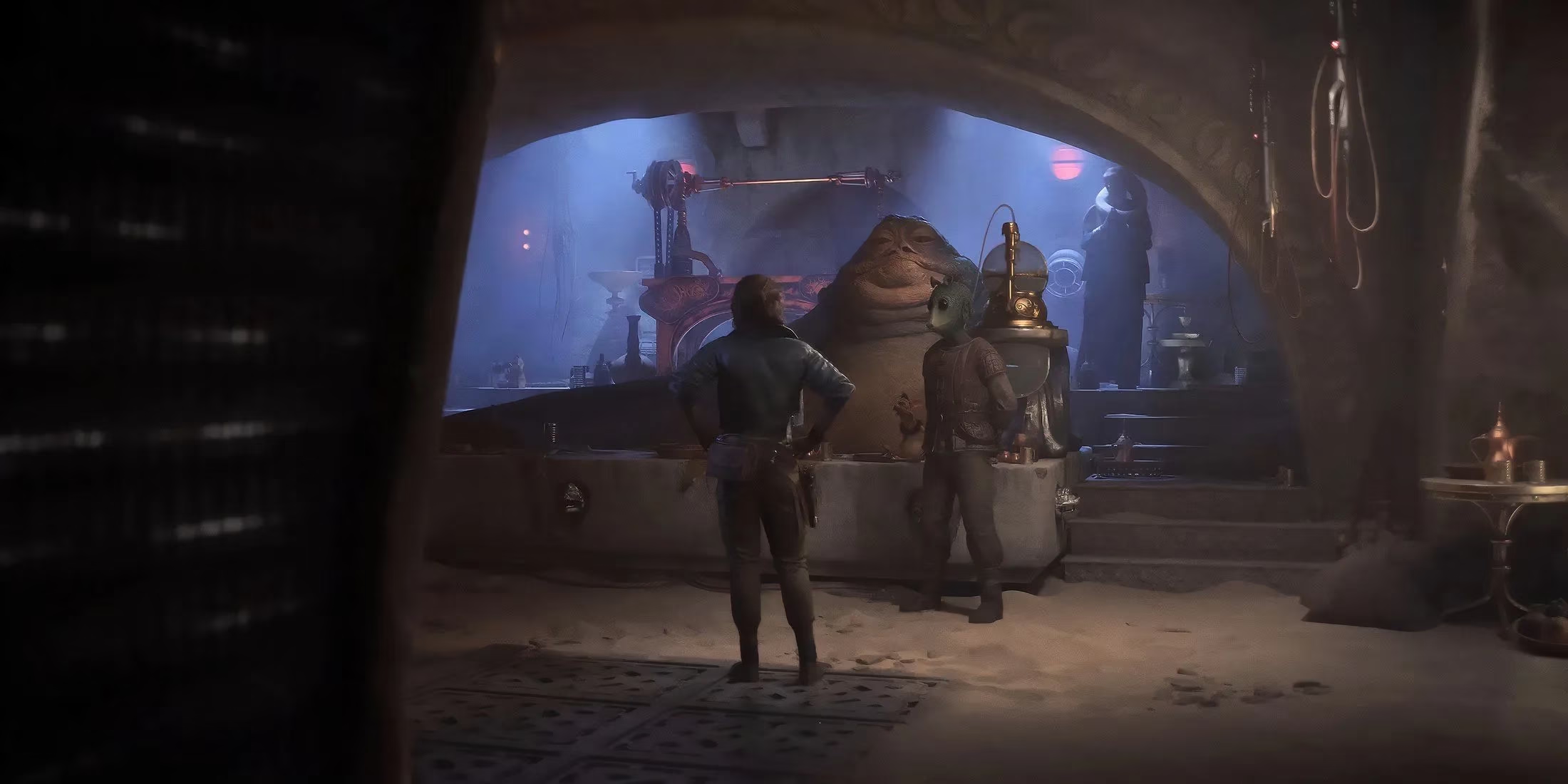
Star Wars Outlaws flips the script by refusing to color its world in black and white. Protagonist Kay Vess isn’t a Jedi hero destined to save the galaxy; she’s a scoundrel on the run, trying to lift a death mark by pulling off a monumental heist. Her motivations are personal, selfish, and gloriously self-serving — yet entirely relatable. This anti-hero premise provides the narrative license to make decisions that would baffle Commander Shepard or a high-karma hero. Instead of a morality gauge, the game deploys a reputation system tied to four criminal syndicates: the Pykes, Crimson Dawn, the Hutt Cartel, and the Ashiga Clan. Each choice boosts standing with one faction while eroding it with another. Crucially, none of these factions are painted as purely righteous or irredeemably evil. The Pykes might offer lucrative smuggling contracts; the Hutts provide formidable enforcers. Your choice isn’t about “good vs. evil” — it’s about what kind of underworld ally you want to court. Is it better to befriend the profit-hungry Pykes for their technological edge, or to curry favor with Jabba’s brutality for sheer intimidation? The game doesn’t judge. It simply observes.
This moral sludge is where Outlaws shines brightest. Consider a mid-game scenario: Kay must decide whether to betray a Crimson Dawn contact to the Hutts in exchange for safe passage. A traditional RPG might label this as a “renegade” or “evil” act, complete with frowny companion disapproval. In Outlaws, however, the consequences are purely pragmatic. The Crimson Dawn will despise you, closing off certain missions and rewards, while the Hutts open new opportunities — both paths are equally valid and narratively rich. No ethereal voice whispers that you’ve disappointed the galaxy. The only compass is your own ambition. How often have players yearned for a game where the “bad” ending isn’t just a grimmer version of events but merely a different one? Outlaws answers that call by making every faction outcome feel like a legitimate conclusion to Kay’s story.
The lesson for Fable and the next Mass Effect is clear, but it’s not without its challenges. The classic hero’s journey inherently imposes moral boundaries. Albion’s fate hinges on a virtuous protagonist; the Reaper threat demands galactic unity. Anti-heroes like Kay are harder to slot into such epic templates. Yet, 2026 demands evolution. Could the new Mass Effect introduce a protagonist who isn’t a Spectre, but a rogue trader operating in the Terminus Systems, where allegiance to Aria T’Loak or the Shadow Broker carries more weight than a paragon score? Could Fable offer a system where your reputation with towns, guilds, and monstrous factions shades your morality in shades of gray rather than a simple halo vs. horns dichotomy? The technology and audience appetite are there. What’s missing is the courage to let players feel genuine discomfort — the kind that comes when a decision benefits a loved companion but screws over an innocent village, without a cosmic scorecard telling you it was “wrong.”
Furthermore, Outlaws shows that consequences shouldn’t always be world-ending. Small, persistent shifts in faction trust create a more believable ecosystem. Getting locked out of a vendor’s wares because you double-crossed them a dozen hours earlier stings far more than a game-over screen prompted by an “evil” choice. This design trusts players to accept the fallout and keep playing, rather than reloading a previous save to chase the golden path. Why do we still see trophy lists that reward “complete the game with maximum reputation” when Outlaws proves that seeing your standing crumble can be just as compelling?
The beauty of the Star Wars Outlaws model lies in its respect for the player’s autonomy. It doesn’t use choices as a filter for a predetermined ending but as a constant, organic storytelling engine. As we move deeper into 2026, with new hardware and increasingly sophisticated narrative tools, the excuse that “the premise prevents moral ambiguity” rings hollow. Gamers have proven they can handle it. They want to be Kay Vess, not just the legendary hero. The ball is now in the court of franchises like Fable and Mass Effect. Will they continue to hold our hand and whisper which path is “best,” or will they cut the strings and let us truly write our own outlaw legend?